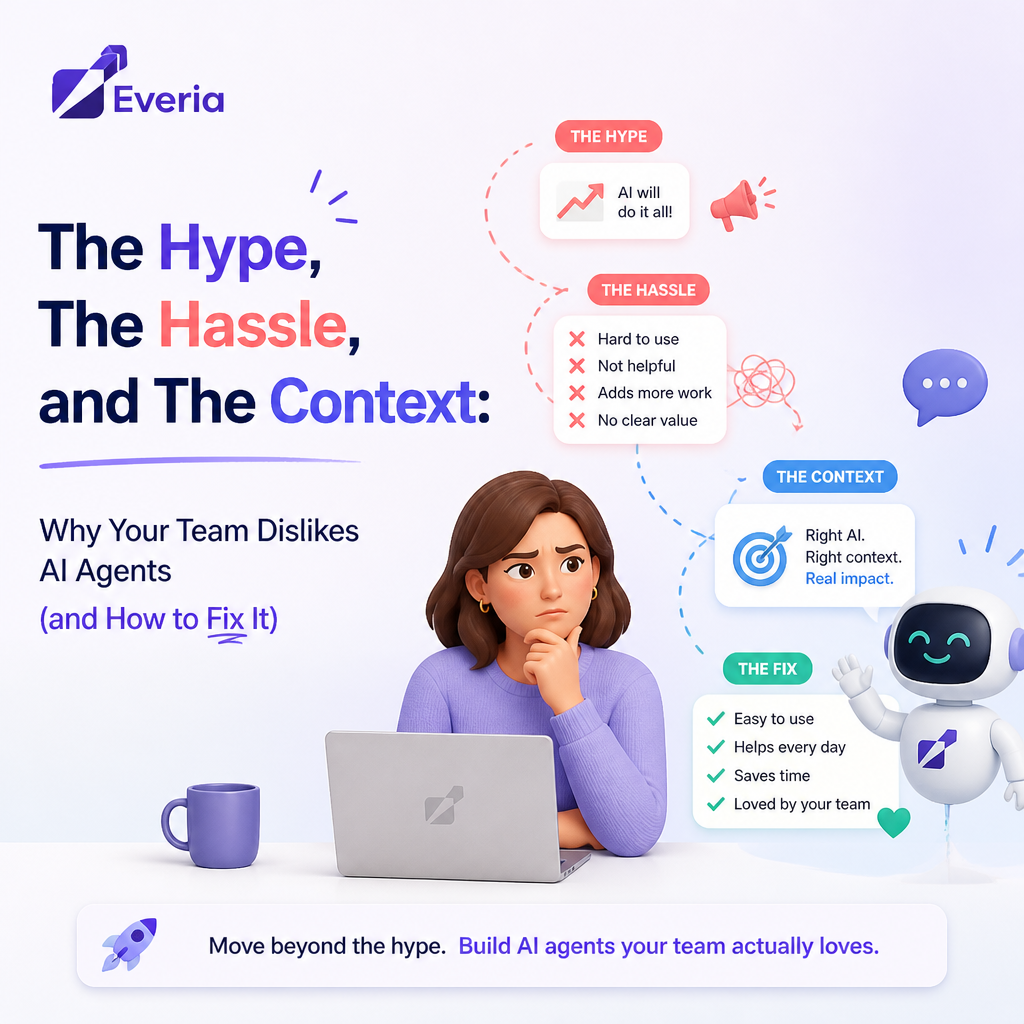
We are officially living through the "Agentic AI" boom. Industry forecasts are bold: research firms like Gartner project that by 2028, at least 15% of daily business decisions will be made autonomously by agentic AI, compared to virtually zero just a couple of years ago.
Yet, if you ask the actual engineers, product leads, and digital marketers executing sprints on the ground, the reality feels incredibly messy.
According to a comprehensive 2026 industry survey, a staggering 62% of professional respondents state that AI agents do not live up to the hype yet, with many describing them as too early-stage or, worse, as tools that create more work than they remove.
The problem isn't that the models are unintelligent. The problem is structural. When AI agents are bolted onto fragmented workspaces as external integrations or superficial point plugins, they lack the baseline environment needed to succeed.
True operational velocity doesn't come from forcing your team to prompt an isolated chatbot. It comes from embedding context-aware, autonomous intelligence directly into a natively converged workspace database.
Deconstructing the 2026 AI Agent Paradox
The metrics from a recent workplace study uncover a clear disconnect between what leaders expect from AI agents and the friction teams encounter when trying to use them:
The Core Metric | The Root Workplace Frustration | The Structural Cause |
40% Need Deep Context | Respondents state that a perfect understanding of their work context is the single most critical factor for making AI agents useful. | Most agents function in an isolated silo. They respond to generic instructions without knowing your team's historical data or specific processes. |
30% Endure False Confidence | Workers cite the "Confident Guesser" problem as their biggest irritation, where standalone agents output incorrect details authoritatively. | Without a live connection to your docs, sprint ledgers, and chats, isolated AI tools guess or hallucinate parameters to fill data gaps. |
25% Suffer Setup Friction | 25% of users find agents too hard to configure, stating it takes too many manual steps or complex pipeline setups just to execute basic tasks. | Forcing standalone agents to work requires complex middleware, constant data plumbing, and custom API connections that regularly drift or break. |
Why Legacy Stacks Create "Work About Work"
When an AI agent operates in isolation from your primary system of record, it triggers an automation bottleneck during the handoff phase.
[Traditional Siloed Path]:
1. Prompt Chatbot ➡️ 2. Get Output ➡️ 3. Clean Text ➡️ 4. Copy to Project Tool ➡️ 5. Manually Create Sprint Tasks (High Friction)

[Everia's Converged Path]:
1. Agent Reads Native Workspace Doc ➡️ 2. Automatically Generates & Deploys Subtasks Across Active Sprints (Zero Friction)
If your marketing or development team has to summarize a meeting using an external browser extension, clean the text, open a separate project tracker, manually format issue cards, and assign owners, the tool hasn't actually saved them time. It has simply introduced a new type of administrative overhead.
According to the Asana Anatomy of Work Report, knowledge workers still lose up to 60% of their day to "work about work", the coordination, app-switching, and status-chasing that distracts from core execution. AI shouldn't add to this burden.
Architectural Deep Dive: Everia vs. Fragmented AI Tools
To build a high-performing product strategy, leadership teams must evaluate their infrastructure across these critical operational vectors:
Operational Parameter | Fragmented Point Tools + Plugins | Natively Converged Environment (Everia) |
Context Integration | Siloed. Requires manual copying, pasting, and continuous text prompting to provide baseline background info. | Ambient. The agent works directly from a unified ledger of your requirements, tasks, and historical project data. |
Data Security & Sovereignty | High Risk. Sensitive product specifications are routinely sent across public consumer web extensions. | Secure. Built from the ground up to respect strict European data protection principles and strict privacy boundaries. |
Operational Scaling Cost | Penalizing. Rigid per-user seat pricing that causes software costs to skyrocket when onboarding contractors or external teams. | Predictable. A transparent flat-rate pricing tier for your entire company, allowing you to scale with unlimited users. |
Onboarding Complexity | High. Days spent mapping custom fields, configuring middleware integrations, and troubleshooting broken endpoints. | Instant. A streamlined workspace design that allows cross-functional teams to deploy live sprints in under 5 minutes. |
Moving from Prompting to Autopilot Execution
ClickUp’s data highlights a massive hidden opportunity: 46% of workers state that the single greatest potential benefit of AI agents is reclaiming time they didn’t realize they were losing.
Reclaiming that time doesn't happen by generating a single paragraph faster. It happens by completely collapsing the transitions between your core apps.
+-------------------------------------------------------------------------+
|                       THE NATIVE AGENTIC CYCLE                          |
|                                                                 |
| 1. Product Spec Written ➡️ 2. Everia Agent Extracts ➡️ 3. Tasks Populated  |
|    (In Native Docs)            Scope & Dependencies       (In Live Sprints) |
+-------------------------------------------------------------------------+
1. Automatic Scope Decomposition
Instead of manually translating a product brief into twenty individual task entries, Everia’s native workspace intelligence parses written project files automatically. It maps dependencies, builds clear task cards, and structures your sprint pipeline directly inside the core database.
2. Live Workspace Synthesis
When cross-functional leaders need a status check, they don’t need to crawl through fragmented chat channels or chase team updates. Team members can simply converse with Everia to instantly generate an accurate, hyper-contextual summary of active blockers, derived straight from live task comments and document changes.
3. Frictionless Scale
Because modern execution moves fast, scaling teams can't be slowed down by seat-license approvals or budget reallocations. Everia's flat-rate pricing ensures you can immediately bring on temporary agencies, technical writers, or engineering contractors to collaborate within your secure workspace loop without facing financial penalties.
Eliminate the Tool Tax. Return to Pure Execution.
Stop forcing your team to act as the human integration glue between fragmented software applications and isolated AI tools.
Everia brings your documents, active sprint pipelines, and context-aware intelligence together under a single, highly secure, unified architecture.
Try Everia for Free — Deploy Your Converged Workspace in Under 5 Minutes
Frequently Asked Questions (FAQs)
1. Why do 62% of professionals feel AI agents don't live up to the hype?
According to data from the AI Agent Survey, most standalone AI tools lack work context. They operate in complete isolation from an organization's actual project logs, tasks, and team files. This forces users to waste time manually copying background data back and forth, which creates extra "work about work" instead of eliminating it.
2. What is the "Confident Guesser" problem in AI?
This occurs when an AI tool gives a highly structured, authoritative response that contains incorrect details or hallucinations. This typically happens because the AI lacks visibility into the real-time state of a project. Everia solves this by embedding its intelligence directly into the core workspace database, allowing it to leverage live project context instead of making guesses.
3. How does Everia protect our proprietary product context?
Many legacy platforms require you to connect third-party browser extensions or external plugins, which can transmit internal product details across unsecured public networks. Everia protects your data sovereignty by utilizing secure, native architectures built specifically to adhere to strict European data privacy standards. Your internal roadmaps, docs, and code details are never exposed to public training loops.
4. Why does Everia use a flat-rate pricing model instead of per-user fees?
Per-user billing models penalize companies for growing. When you need to bring on freelance marketers, temporary QA testers, or external engineering contractors, your software bill instantly spikes. Everia offers a predictable flat-rate tier that allows your entire organization to collaborate with unlimited users without facing budget penalties.