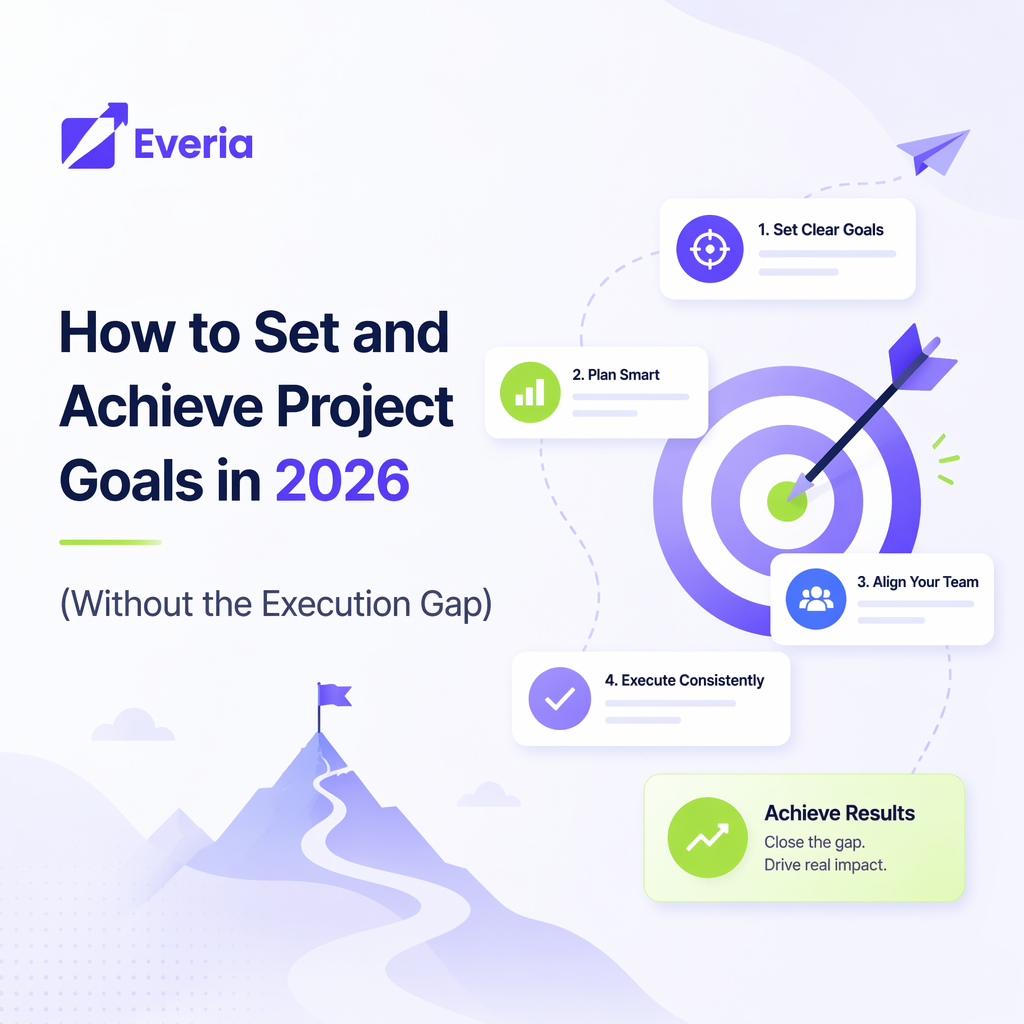
Setting project goals is easy. Achieving them is where things fall apart. According to organizational studies, nearly 70% of corporate projects fail to meet their original goals. It’s not because teams lack ambition or talent. It’s because of the Execution Gap, the physical distance between where your goals are written (a static slide deck or a dusty document) and where your team actually works (isolated task boards and chat threads).
When your goals live in a vacuum, your day-to-day tasks drift away from your target. Below, we break down the science of writing actionable project goals, how they differ from project objectives, and how to use Everia to ensure your team's daily execution is natively linked to your high-level strategy.
Project Goals vs. Project Objectives: What’s the Difference?
While often used interchangeably, goals and objectives serve entirely different functions in a successful project roadmap.
Project Goals: These are broad, high-level, long-term outcomes you want to achieve. They give your team a destination (e.g., "Improve our platform's mobile user experience").
Project Objectives: These are the specific, measurable, time-bound steps required to achieve that goal. They act as your milestones (e.g., "Reduce mobile checkout page load times to under 1.8 seconds by Q3").
The Problem with Traditional Tools: In standard setups, your goals are defined in Notion, your tasks are managed in Jira, and your page-speed metrics are tracked in a developer dashboard. Because these layers don't talk to each other, team members lose sight of why they are working on a specific task.
The SMART Framework for Project Goals
To make sure your project goals actually drive results, they should follow the classic SMART criteria (originally defined by Peter Drucker's management theory; learn more about the SMART Framework on MindTools):
S - Specific ➡️ Clear, unambiguous, and focused.
M - Measurable ➡️ Tracked with concrete metrics (KPIs).
A - Achievable ➡️ Realistic given your team’s resources.
R - Relevant ➡️ Aligned with broader company objectives.
T - Time-Bound ➡️ Anchored to a defined deadline.
Traditional SMART Goal vs. An Everia-Linked SMART Goal
Traditional SMART Goal: "Increase our active workspace registrations by 20% by December 31st using content marketing." (This is a good goal, but it sits passively on a wiki page. Your marketing intern has to manually translate this into weekly tasks).
Everia-Linked SMART Goal: Your goal is documented directly inside your main campaign spec. Because Everia natively converges documentation and task tracking, your content pipeline, short-form video assets, and distribution tasks are directly nested under this goal in the same database layer. When a task is completed, your goal progress updates automatically.
5 Steps to Set and Track Project Goals in Everia
Here is how to set up an execution-proof goal tracking system that keeps your team aligned from day one.
Step 1: Draft the Vision (Docs Layer)
Start by writing your project charter or product brief in an Everia Document. Outline the why behind the project, the target audience, and the overall goals.
Step 2: Establish Your Key Metrics (Objectives)
Break your broad goals down into measurable targets. If your goal is to launch a new product feature, your objectives might be:
Complete frontend development by Week 6.
Resolve all critical QA bugs by Week 8.
Publish 10 promotional assets across social channels by Week 9.
Step 3: Connect Tasks Natively (No Hand-offs)
Instead of copying your goals into a separate project tracker, convert your documented milestones directly into Everia Sprints. Because the documentation and the sprint boards share the same database layer, your developers can click on any task card and instantly read the original project brief for complete context.
Step 4: Run Real-Time QA Loops
Ensure that your quality assurance testing is linked directly to your feature launch goals. Inside Everia, QA tickets are tied natively to the development branch and the original requirement. No third-party bug-tracking apps required.
Step 5: Onboard Collaborators Safely
Do you need freelance designers, agencies, or external contractors to help you reach your deadlines? Avoid the "contractor penalty." Everia offers a predictable flat-rate corporate plan with unlimited user seats, meaning you can scale your project team up or down without worrying about your software bill skyrocketing.
A Real-World Goal Framework for Tech Teams
High-Level Goal | SMART Objective | How Everia Natively Executes It |
Accelerate Product Velocity | Reduce the average feature-release cycle from 21 days to 14 days by Q4. | Eliminates the time wasted on "work about work" by converging requirements, tasks, and QA into one interface. |
Improve System Quality | Drop post-release critical bugs to zero across the next three major deployments. | Integrates developer code commits with native QA testing checklists in the same workspace database. |
Scale Brand Awareness | Launch a 3-month multi-channel campaign yielding 500+ organic trial signups. | Houses marketing roadmap documents, short-form video script templates, and community distribution tracking in one unified hub. |
Frequently Asked Questions
Why do most project goals fail?
Most project goals fail due to fragmentation. Teams write their strategic goals in a document, but run their daily work in separate, disconnected applications. This disconnect creates an "execution gap" where daily tasks slowly drift away from the project's original intent.
How does Everia bridge the gap between goals and daily work?
Unlike traditional tools (like Jira or Notion) that require you to jump between different apps to see your documentation and your tasks, Everia unifies both layers. Your project goals, requirements, sprint tasks, and QA boards all live under a single database layer. Everyone on the team has absolute context on why they are building a specific feature.
Can we track OKRs (Objectives and Key Results) in Everia?
Absolutely. Everia is built to support agile, modern goal-tracking frameworks like OKRs. You can document your high-level Objectives in your team wiki pages and link key task lists, development milestones, and quantitative QA metrics directly to them as Key Results.
Is our project data safe on Everia?
Yes. Everia is engineered from the ground up to comply with strict European data sovereignty and privacy standards. Your sensitive strategic goals, corporate documentation, and proprietary code integrations are fully protected and never leaked to public AI training loops.
Align Your Strategy with Your Execution
Stop letting your project goals gather dust in disconnected tabs. Give your team a single, unified database where plans, tasks, and quality control align perfectly.
Bring your goals to life ➡️ Try Everia for free today